About this video
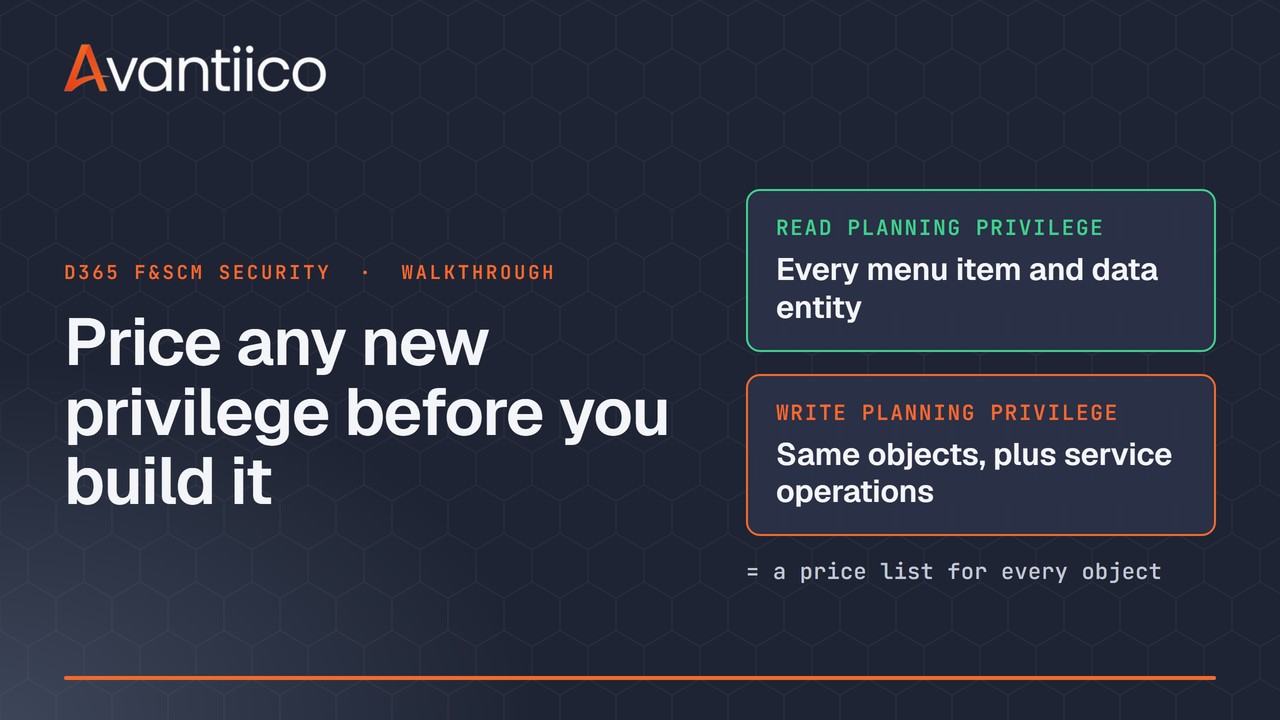
Microsoft Learn says that when Access level is Read, the license is no higher than Team Members or Human Resources Self Service. We tested what that means in a 10.0.49 test environment. It holds for Microsoft's own read-only privileges, and it breaks for read-only privileges you build yourself.
What the data shows
- All 9,735 Microsoft read-only privileges are Team Members, Human Resources Self Service, or no license.
- 5,036 objects still need a paid license at Read (3,862 a full license, 1,174 Operations - Activity), and no Microsoft privilege grants any of them at Read.
- Where no single Microsoft View privilege covers all the paid objects, 97% of read-only copies stayed paid.
- Of the objects that need a paid license at Write, Read keeps it for 92% of action menu items, 73% of output menu items, 37% of display menu items, and 11% of data entities.
- A single object has no halfway step: it keeps the same license at Read, or drops to Team Members, Human Resources Self Service, or none.
Six checks before you swap Write for Read
- Look for a Microsoft View privilege that covers every paid object.
- No full View privilege? Assume Read costs the same as Write.
- Price your own read-only privilege object by object.
- Count the seat, not the privilege.
- Don't count read-only actions as savings.
- Test it in a sandbox before you quote savings.
Companion article
Swapping Write for Read Doesn't Always Lower the License: What Microsoft Learn's Team Members Rule Leaves Out
Chapters
- 0:00The Learn rule
- 0:18Where it holds
- 0:30Where it breaks: 5,036 objects
- 0:49Copying a privilege and setting it to Read
- 1:06Results by object type
- 1:27One object: no halfway step
- 1:39Example: accounts receivable parameters
- 2:07Why production data won't warn you
- 2:43Six checks before you swap
- 3:07Full analysis