
A user who needs both Finance and Supply Chain Management pays $210 for one base license plus $30 for the other as an attach, $240 total. It makes no difference which of the two Microsoft calls the base. Both are priced at $210, so the assignment is interchangeable, and the total never moves.
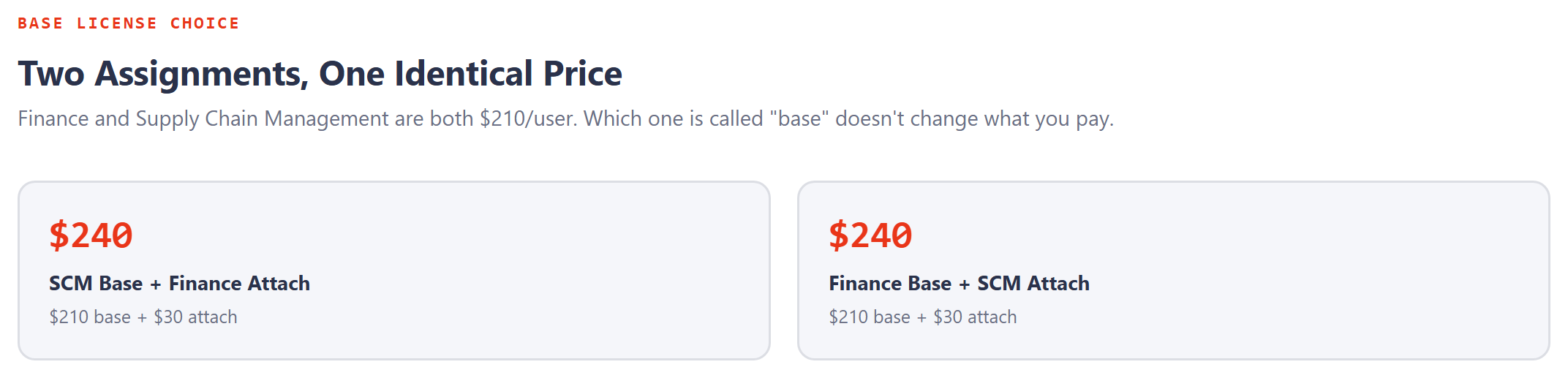
That sounds obvious once stated, but it's the entire mechanism behind one of the more useful moves in license optimization: deliberately assigning someone a base license for an application they don't personally use, because it costs the company nothing extra and it can avoid triggering an expensive minimum elsewhere.
This workbook isn't our analysis service. It recalculates licenses for the security you have today. See how it differs from the paid analysis.
The rule Microsoft's Product Terms actually require
Every full user needs exactly one base license, the highest-priced license they hold, and every other full application becomes a much cheaper attach license. Microsoft's requirement is only that the base be the user's highest-priced license. It says nothing about which specific application that has to be when two or more are priced identically, which is exactly the gap this works inside of.
Which pairs actually swap for free
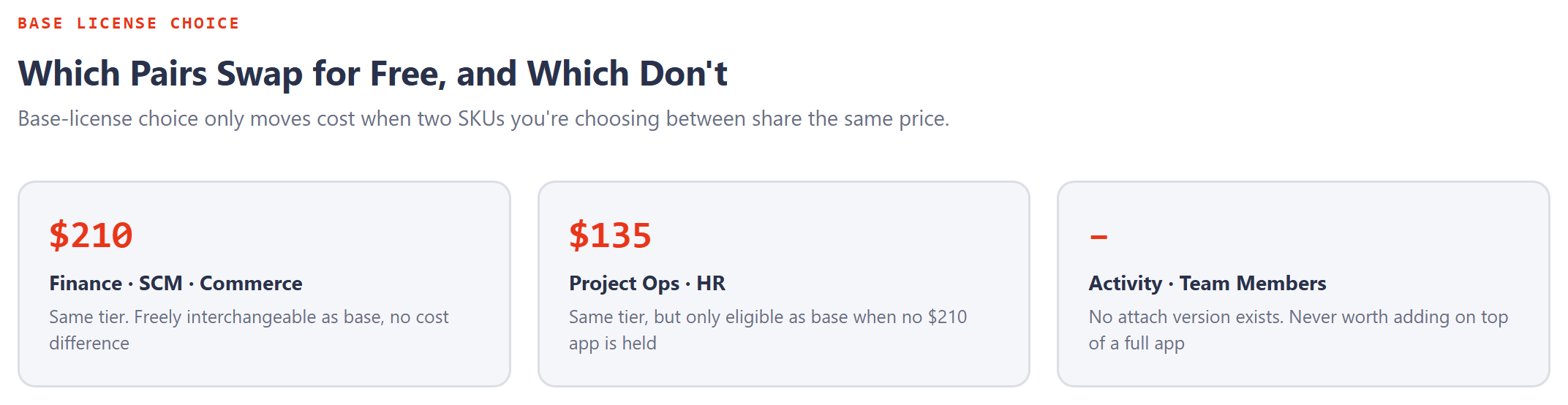
- Finance, Supply Chain Management, and Commerce ($210 each) are freely interchangeable as the base. A user needing any combination of these three can have any one of them as base with zero cost difference.
- Project Operations and Human Resources ($135 each) can only serve as base when the user holds no $210-tier application at all. The moment a $210 app enters the picture, one of those becomes base instead.
- Operations-Activity and Team Members have no attach version. A user who needs a full application never needs Activity or Team Members on top of it, and a user who needs Activity never separately needs Team Members.
When the choice stops being free
Swapping is cost-neutral only when it stays inside one price tier. It stops being free in three situations:
- A minimum is in play. If giving six users a dedicated Commerce base would trigger Commerce's unused 20-seat minimum, assigning them an SCM base instead, when SCM is already past its own minimum from other users, avoids a brand new minimum entirely. This is the exact mechanic behind the worked example in our License Optimization Model, and the broader minimum-purchase problem it's solving for is covered in why Microsoft's minimums mean you've already overbought.
- Premium tiers are involved. Finance Premium and SCM Premium are both $300, a different tier from the $210 standard SKUs. An unused Premium seat can cover its own standard-tier need, but that's a different mechanism (Premium-to-standard coverage), not a same-tier base swap.
- Ownership is asymmetric. Even inside the same tier, if you own far more of one SKU than another, reclassification considerations can make one base choice cheaper to execute than another, independent of the sticker price being identical.
A base license assigned to a user who doesn't personally use that application is still a real, visible assignment. The Power Platform admin center will report that user as over-licensed. Don't remove it: without a qualifying base, the attach license it's carrying loses its eligibility, and whatever minimum the swap was avoiding comes right back. Confirm with your Microsoft partner whether this kind of added base is something your agreement treats the same way before relying on it.
Base license choice is a free lever exactly as often as two candidate SKUs share a price. Outside that, it's not free, it's a different kind of decision entirely.
Before assuming a user's base license is fixed by what they personally use, check whether a same-priced alternative exists. If it does, which one is base is a lever you control at zero cost, not a fact about the user's job.
Free workbook or paid analysis: what's the difference?
The free workbook recalculates the cheapest license mix for the security you already have, which the Power Platform admin center report doesn't fully optimize. The paid analysis finds the permissions people don't use, and that's where the larger savings are.
| Free workbook | Paid analysis | |
|---|---|---|
| What it does | Recalculates licenses. Your security stays as it is, so it can't reduce what that security requires | Proposes a redesign that keeps the access people need. Your managers decide |
| What to expect | A lower bill when the license mix or purchase minimums are the problem | Usually 20 to 30% of the bill you'd otherwise pay, once the redesign is deployed |
| Who runs it | You | We run the analysis. We or your team deploy |
| Cost | Free | Paid: at 20 to 30%, it saves $200,000 to $300,000 a year per $1 million of the bill you'd otherwise pay. Deployment is priced separately |
Download the free License Optimization Model, or see how the paid analysis works.
Related reading: our free License Optimization Model makes this exact choice automatically across your whole tenant, Microsoft's purchase minimums force overbuying covers the problem this lever most often solves, and our plain-English primer on D365 F&SC license types is the place to start on the SKU names used here.