
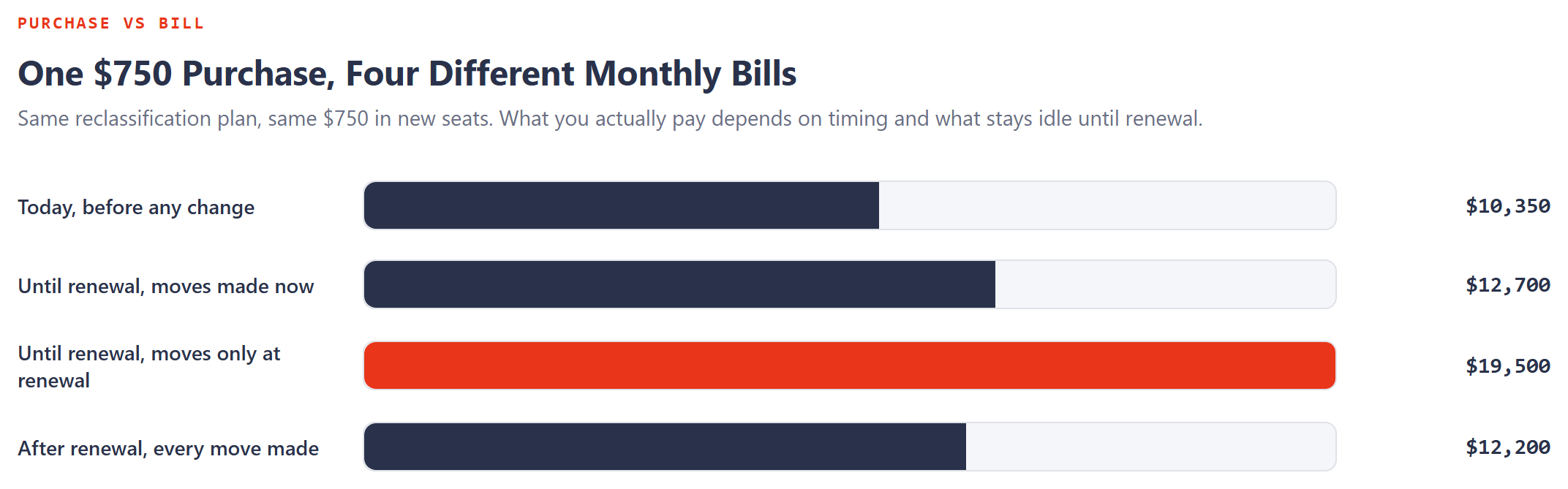
25 users need Finance and Supply Chain Management. 6 need Commerce. 40 need Operations-Activity. The company already owns 30 Finance, 5 SCM, and 60 Activity seats. The cheapest reclassification plan available, the one that spends only $750 on new seats, raises the monthly bill from $10,350 today to $12,700 until renewal, and only settles at $12,200 after the unused seats are finally dropped.
That's not a mistake in the plan. It's what happens when a license model optimizes for the smallest new purchase, not the smallest monthly bill, and the two are not the same target.
This workbook isn't our analysis service. It recalculates licenses for the security you have today. See how it differs from the paid analysis.
Why the purchase total and the bill diverge
Reclassifying an owned seat to cover a shortage counts as free in the purchase total, since no new seat was bought. But that seat still gets billed from then on, at its new SKU's price, not its old one. Moving an Operations-Activity seat ($50) onto Supply Chain Management ($210) is a $0 line item in "Estimated Purchase Cost" and a $160-a-month increase in the actual bill. The purchase total and the bill are answering two different questions, and only one of them is what an executive actually needs to see.
The five-step order behind every reclassification
Reclassification doesn't move seats arbitrarily. It follows a fixed order, using only what's left over after the step before it:
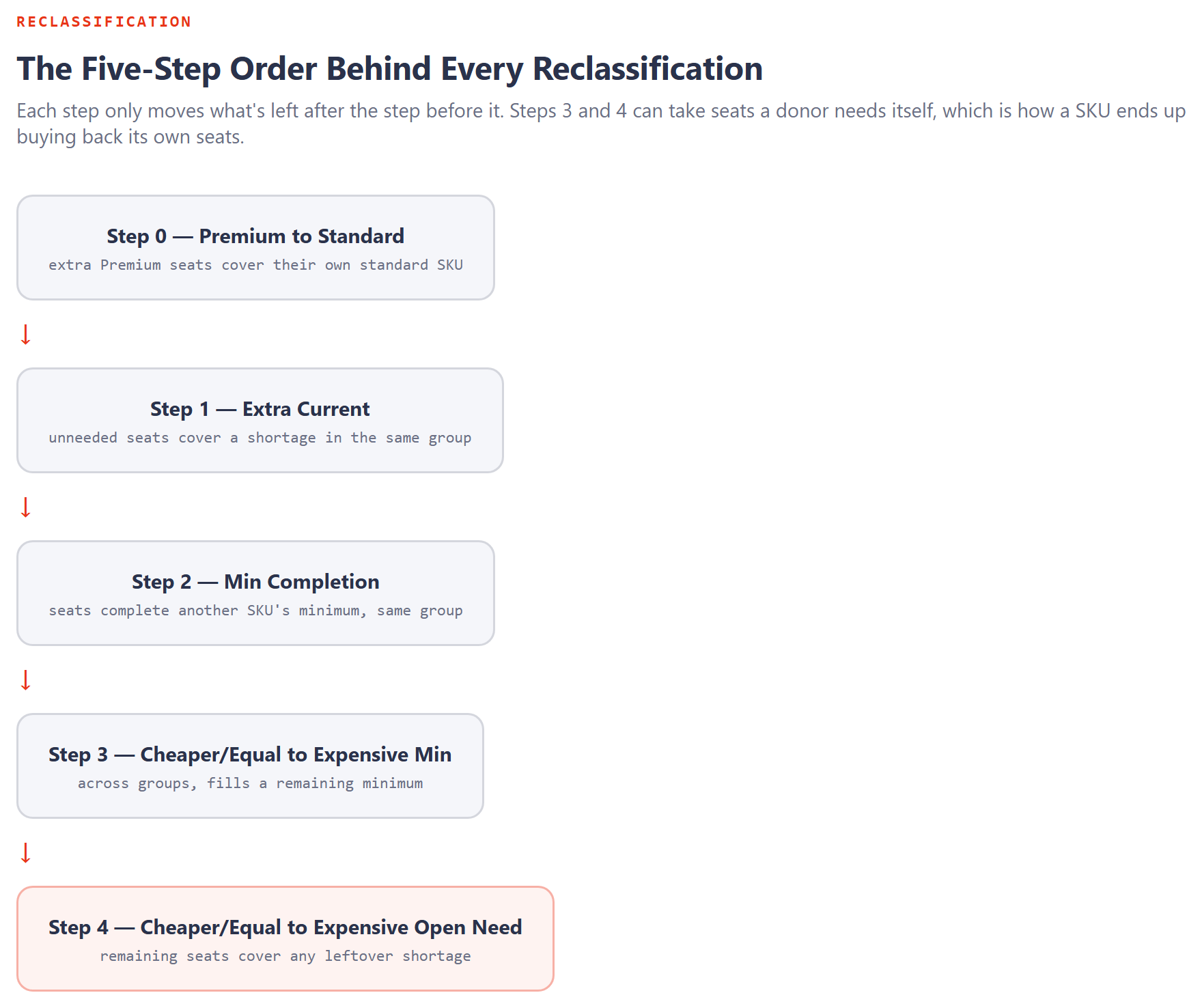
Commercial groups matter here too: Finance, Supply Chain Management, and Commerce form one group; Project Operations and Human Resources form another; every attach SKU forms a third. Operations-Activity and Team Members belong to no group and only ever participate in steps 3 and 4. Because those later steps can pull more seats than a donor SKU actually has spare, a SKU can show up needing a new purchase even though you technically own more of it than required, the seats that got pulled to complete someone else's minimum are bought back on the donor's own line.
The worked example, in full
In this scenario, keeping Microsoft's default base choice (SCM as base, Finance as attach) turns out cheapest to purchase, since no alternative assignment has a lower estimated purchase cost:
| SKU | Current | Min | Required | Qty to Own | Reclass In | Reclass Out | Extra after Reclass | Qty to Purchase | Cost |
|---|---|---|---|---|---|---|---|---|---|
| Supply Chain Management | 5 | 20 | 25 | 25 | 20 | 0 | 0 | 0 | $0 |
| Finance | 30 | 20 | 0 | 0 | 0 | 30 | 0 | 0 | $0 |
| Finance Attach | 0 | 0 | 25 | 25 | 0 | 0 | 0 | 25 | $750 |
| Commerce | 0 | 20 | 6 | 20 | 20 | 0 | 0 | 0 | $0 |
| Operations-Activity | 60 | 0 | 40 | 40 | 0 | 10 | 10 | 0 | $0 |
| Total | $750 |
The moves behind this: 20 Finance seats move to Commerce, 10 Finance seats move to Supply Chain Management, 10 Operations-Activity seats move to Supply Chain Management. Only the 25 new Finance Attach seats cost anything to buy. Everything else is reclassification of seats already owned. Operations-Activity's remaining 10 "Extra after Reclass" seats are neither purchased nor reclassified, they stay billed at the old rate until renewal, which is exactly the gap the next section's until-renewal numbers account for.
If those moves can only happen at renewal, not during the current term, don't run this plan as-is. The 20 SCM and 20 Commerce seats needed to clear their minimums would have to be bought now in addition, while the 30 Finance and 20 Activity seats stay billed until renewal regardless, pushing the until-renewal bill to $19,500 instead of $12,700. Confirm timing with your Microsoft partner before committing to any reclassification plan.
A cheaper bill can cost more to buy
An alternative plan exists for the six Commerce users: give them a Supply Chain Management base instead of a dedicated Commerce base (the same mechanism covered in our piece on base license choice), reclassifying 26 of the 30 Finance seats to SCM. That plan costs more to buy, $930 instead of $750, but produces a lower bill: $11,280 instead of $12,700 immediately after the change, and $9,440 instead of $12,200 once idle seats are dropped at renewal.
The model minimizes new purchases by default. When you own a large number of unused seats, compare the full bill across alternatives before deciding, the cheapest purchase and the cheapest bill are frequently two different plans.
Never sign off on a reclassification plan using its purchase cost alone. Ask for the actual monthly bill, today, until renewal under both timing assumptions, and after renewal, before deciding which plan to run.
Free workbook or paid analysis: what's the difference?
The free workbook recalculates the cheapest license mix for the security you already have, which the Power Platform admin center report doesn't fully optimize. The paid analysis finds the permissions people don't use, and that's where the larger savings are.
| Free workbook | Paid analysis | |
|---|---|---|
| What it does | Recalculates licenses. Your security stays as it is, so it can't reduce what that security requires | Proposes a redesign that keeps the access people need. Your managers decide |
| What to expect | A lower bill when the license mix or purchase minimums are the problem | Usually 20 to 30% of the bill you'd otherwise pay, once the redesign is deployed |
| Who runs it | You | We run the analysis. We or your team deploy |
| Cost | Free | Paid: at 20 to 30%, it saves $200,000 to $300,000 a year per $1 million of the bill you'd otherwise pay. Deployment is priced separately |
Download the free License Optimization Model, or see how the paid analysis works.
Related reading: our free License Optimization Model calculates all four bill lines automatically, Microsoft's purchase minimums force overbuying covers why these minimums exist in the first place, and which license should be your base covers the alternative plan referenced above in depth.