
Ask most finance leaders what "optimizing D365 licensing" means, and the answer is almost always the same: negotiate harder at renewal. Squeeze the reseller. Get five, ten, maybe twenty-five percent off list price. It's the only lever most companies have ever pulled, so it's the only lever they know exists.
A discount and an optimization solve two different problems, and confusing them is the single most expensive mistake we see in D365 F&SC licensing conversations.
What a discount actually does
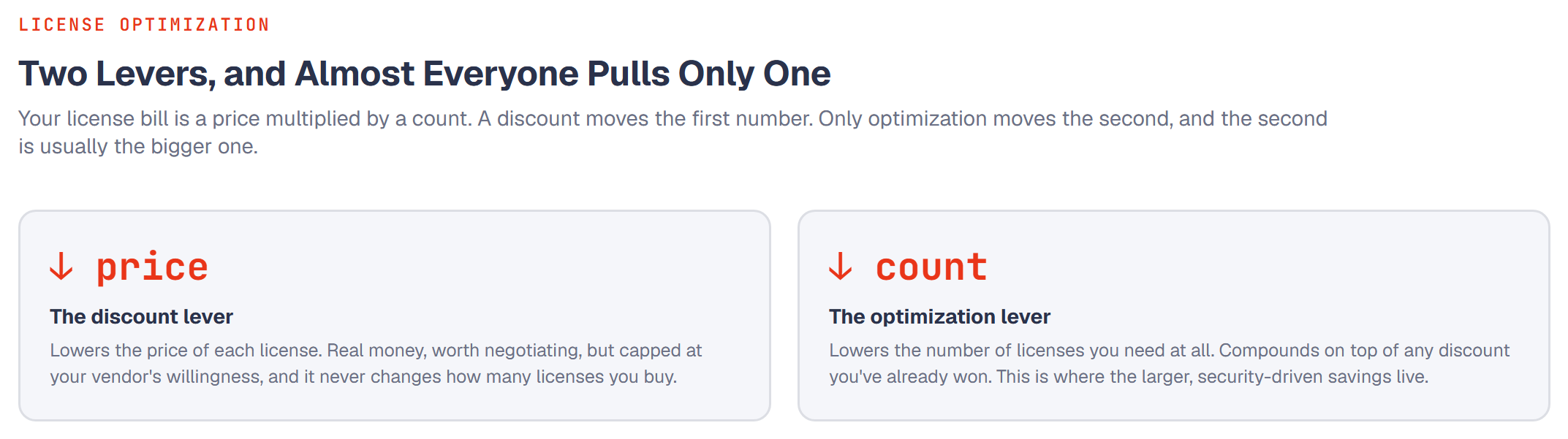
A discount changes the price of a license you're going to buy anyway. It's real money, and it's worth negotiating. But it does nothing about the number of licenses you're buying in the first place, and that number is almost always the bigger problem.
A 20% discount on 700 unnecessary licenses is still 700 unnecessary licenses. The count is the lever that moves real money, and it's the one almost nobody touches.
What the second lever is actually worth
We published two case studies this year that show the size of the gap a discount never reaches.
In one engagement, a European D365 F&SC estate with roughly 700 licensed users, and security that was already among the best-configured we've assessed, was still paying $105,000 a month. No obvious waste, no sloppy roles, nothing a discount negotiation would have caught. Comparing what was granted against what people actually did in the system, not what a discount would have changed, brought that down to about $65,000 a month. Full details in the write-up.
In another, a client running roughly 150 licensed users had a fairly ordinary security setup, nothing dramatic, just the usual accumulation of access nobody had revisited. The full remediation, generated and deployed as importable security configuration rather than built by hand, took about ninety minutes and cut the monthly bill from a projected $43,000 to about $32,000. That's covered in this case study.
Neither of those numbers came from a better conversation with Microsoft or a reseller. They came from tracing every license requirement back to the specific role, duty, or privilege actually driving it, then removing what the evidence didn't support.
Why this gets missed so often
It's not that finance and procurement teams are careless. It's that the discount conversation is the one everyone already knows how to have. Security configuration, the thing actually driving how many licenses you need, sits in a different department, gets reviewed on a different schedule, and rarely gets connected back to the license bill at all. The two teams that could close this gap usually aren't in the same meeting.
If your last cost-reduction conversation was entirely about discount percentage, you've only pulled one of two available levers. The second one is usually worth more, and it's the one sitting untouched in your own security configuration right now.
Curious what the second lever is worth on your own tenant? See how the full analysis works in our licensing fundamentals guide, or skip straight to a conversation about your own numbers.