
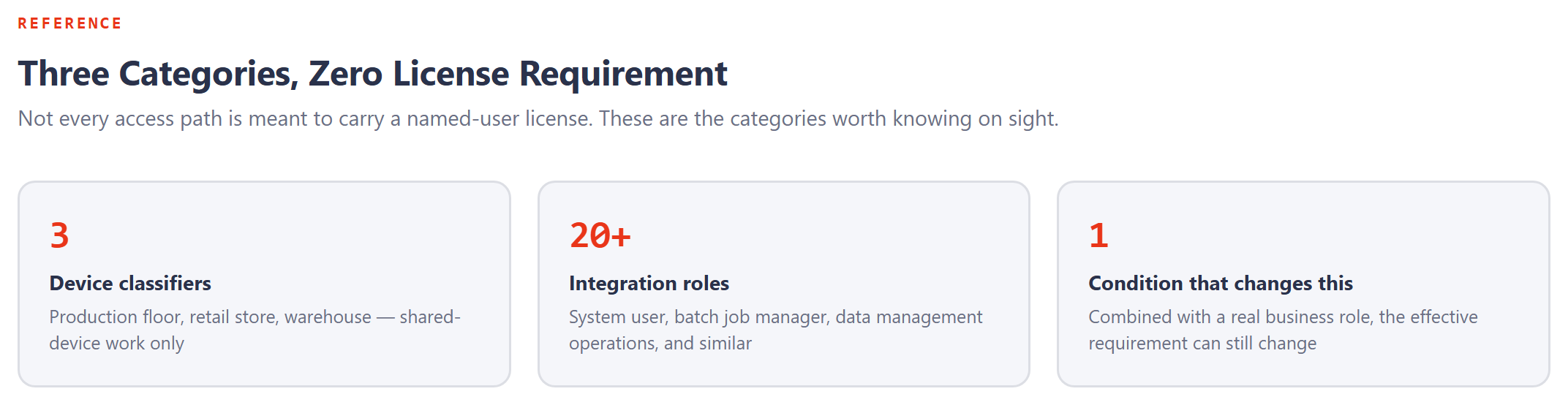
A large set of D365 F&SC roles carries no license requirement at all when assigned on its own. Most of them exist to classify device-only work or to support integrations, background jobs, and administrative plumbing rather than named-user business activity. This is a working reference, not the full Microsoft catalog. Verify any role's current treatment against the licensing guide before making a final entitlement decision, since Microsoft updates this guidance regularly.
Device-based classifier roles
Built specifically for shared-device scenarios in manufacturing, warehousing, and retail:
- Device based, production floor worker
- Device based, retail store manager
- Device based, warehouse worker
These classify people who work only through a shared device. Assigned to someone functioning as a standard named business user, they stop reflecting reality. See our earlier piece on device roles for why that distinction matters.
Integration and background-operation roles
A sample of the roles most commonly seen carrying no license requirement on their own:
- System user, System administrator, System external user
- Security administrator
- Batch job manager
- Business events security role
- Power Automate administrator
- Data management administrator, migration user, and operations user
- Electronic reporting developer and functional consultant
- Master data change operator
- Saved views administrator
- Scale unit administrator and management
- Warehouse mobile device user
- Workload administrator
- Vendor admin, vendor contact, and vendor prospect (external)
This list is longer in practice. Dozens of narrower roles exist for specific platform functions (document routing, learning integration, IoT messaging, field service integration, and similar). The pattern that matters more than any individual name: if a role's only function is service-to-service traffic, background processing, or platform administration with no interactive business functionality, it's a strong candidate for no-license treatment.
None of these roles are automatically exempt forever. A no-license role combined with a genuine business role can still change a user's effective requirement. Always review the full combination a person holds, not any single role in isolation.
For the deeper version of this distinction, including why device and service roles both still need active governance even though neither carries a license on its own, see The Roles Doing Too Much.