
In October 2026 an estate that had split its main roles by license type asked us: "Has the new security configuration reduced our segregation-of-duties risk?" About 700 people had moved to the new roles. The SoD reports from before and after couldn't answer it.
A 9% drop in High-risk conflicts and "77% of High-risk holders kept the same number of High risks" are both true here. Report people and their levels first.
The reports came from different engine versions, populations, and roles. We re-scored the earlier data with the current engine, measured as users assigned to roles with a risk: counting only enabled accounts cut the figure by 10%, ignoring Deny restrictions then added 15%, and counting administrators as ordinary users added a little more. That moves the figure as much as many remediations do. Here is the method we used instead; its results across five estates are in license optimization doesn't fix segregation of duties.
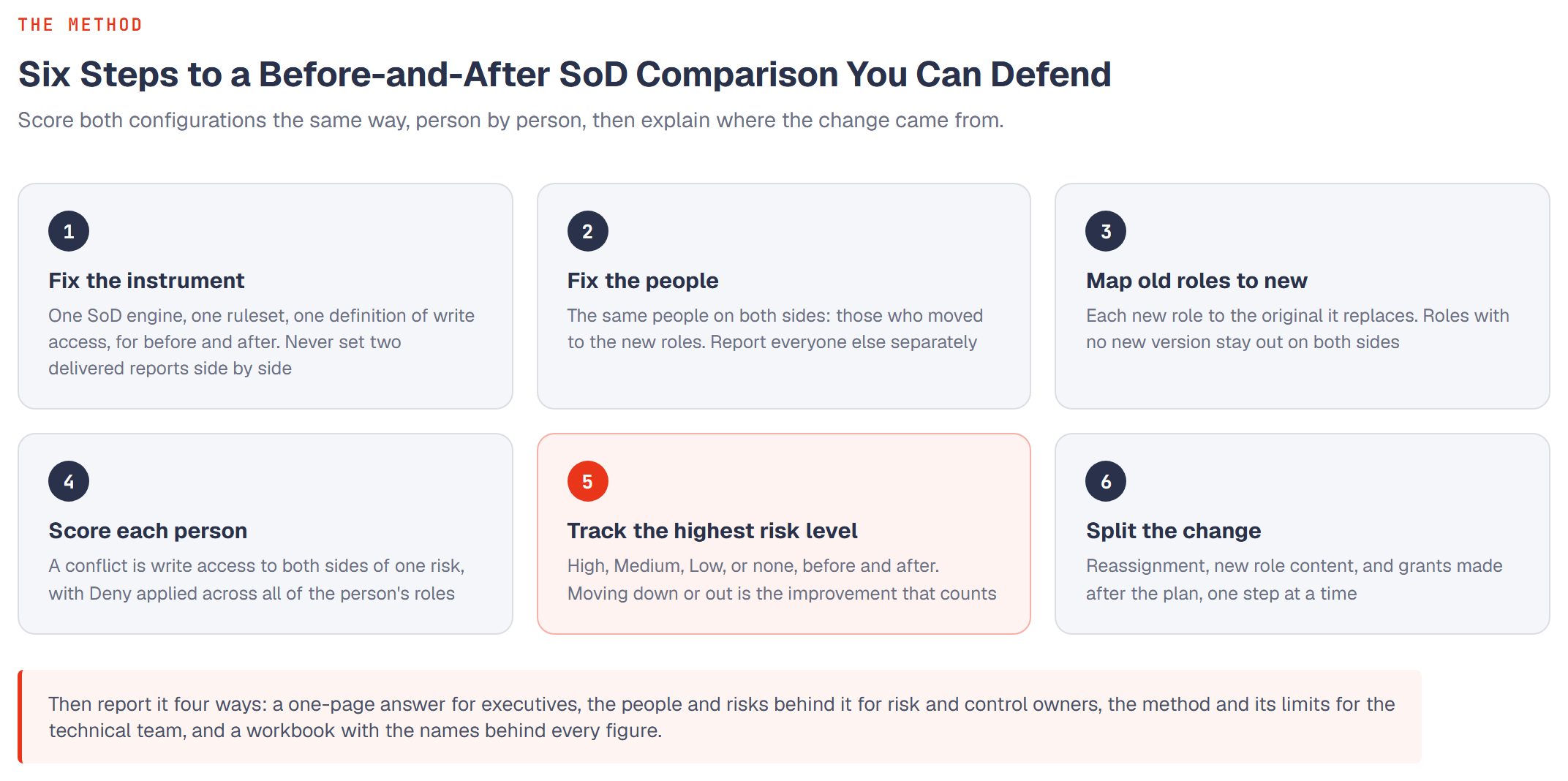
Fix the instrument
Score both configurations with one engine version, one ruleset, and one definition of write access, re-scoring the old configuration from its own security extraction instead of reusing the delivered report. In our engine, write access is a write verb (Update, Create, Delete, or Correct) granted and not denied, with Read not denied; a Deny on any of a person's roles removes it across all of them. A rebuilt engine should first reproduce a production run row for row, as ours did.
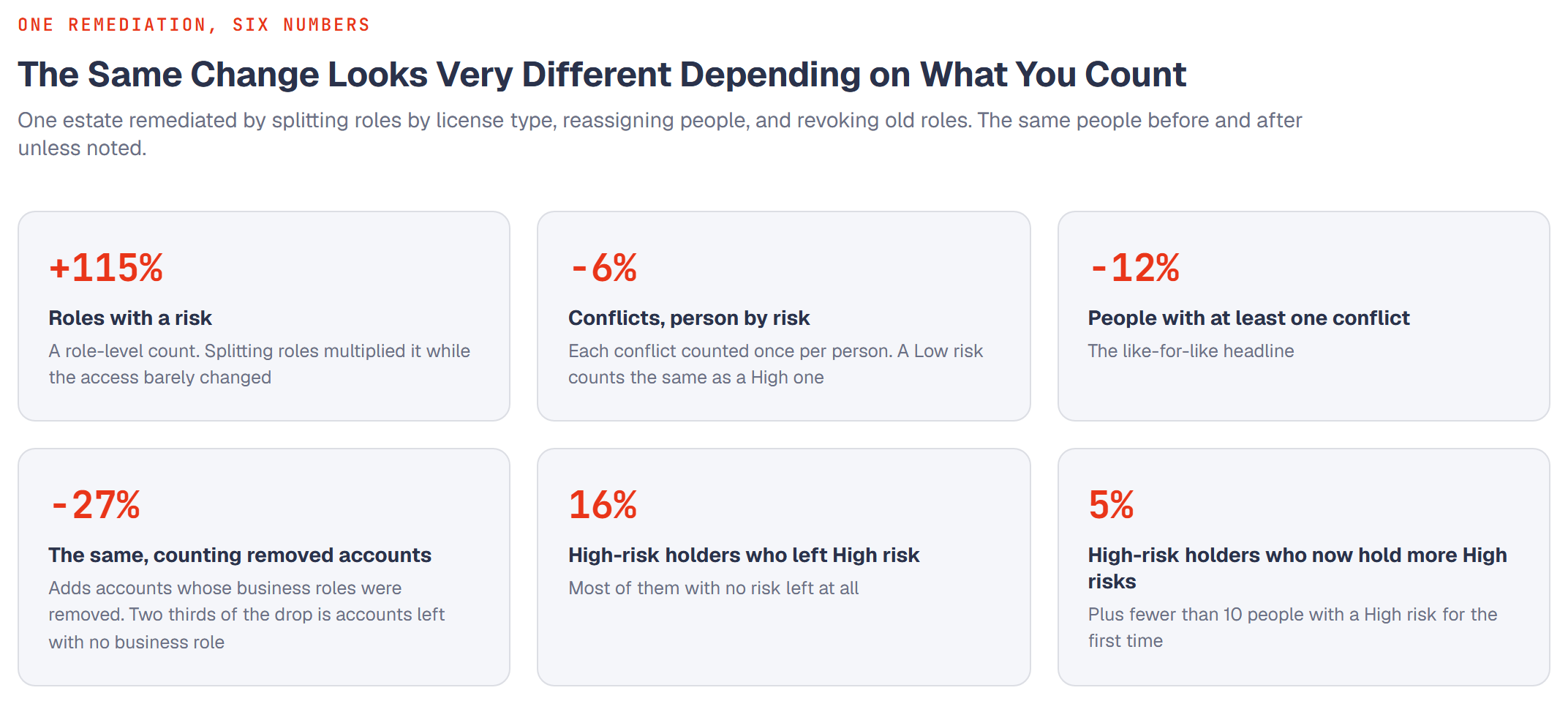
The ruleset sets the size of the answer. Across the estates we measured, the same ruleset put the share of active people with a conflict anywhere from 34% to 97%, and a narrower variant cut conflict counts by 34% to 70%. It needn't be perfect, only the same on both sides, with a second variant as a sensitivity check. Here, people with a conflict fell 12% under the full ruleset and 13% under the narrower one, so the direction is safe to report. Your SoD conflict count is mostly an artifact of the ruleset explains why the absolute number isn't.
Fix the people
Compare the same people: everyone who held an old role before and holds the new roles now. People still holding only old roles haven't moved yet, so they're named in a separate list, as are system administrators, who can do everything in both configurations.
Accounts whose business roles were all removed drop out of risk by definition: counting them turned the 12% drop into 27%, two thirds of it accounts left with no business role. Report that cleanup on its own line. Old roles granted after the plan to people on new roles are current access, so they count, and their holders go on the review list.
Map old roles to new, and count people, not roles
Map each new role to the original it replaces; with a naming convention, such as the original name plus a license suffix, one pattern does it. Check that every original exists, unchanged, in both extractions. Roles with no new version stay out on both sides, assuming everyone eventually moves.
Then stop counting roles. The split by license type more than doubled the roles with a risk, up 115%, yet a person holding every version of a role still had 99% of the original's conflicts, and 59% of the versions of conflict-carrying roles kept all of them. A role count after a split measures the split, not the risk.
Score each person, and name the outcome
For each person, list the conflicts before and after, removed and new, then assign one outcome: fewer (some removed, none new), more (some new, none removed), some fewer and some new, the same, or none either time. Of the people with a conflict before or after, 39% had fewer, 53% the same, 6% more, and 2% some fewer and some new.
Each person with a new conflict needs a name, the roles behind it, and an owner who decides whether the role is needed. About half had received roles they didn't hold before, most of the rest had late grants of old roles, and one had a license version of a role carrying a conflict its original didn't.
Track each person's highest risk level
A conflict count treats a High risk like a Low one, but owners ask whether each person moved down or out of risk. So give each person their highest risk level before and after, High, Medium, Low, or none, and cross-tabulate.
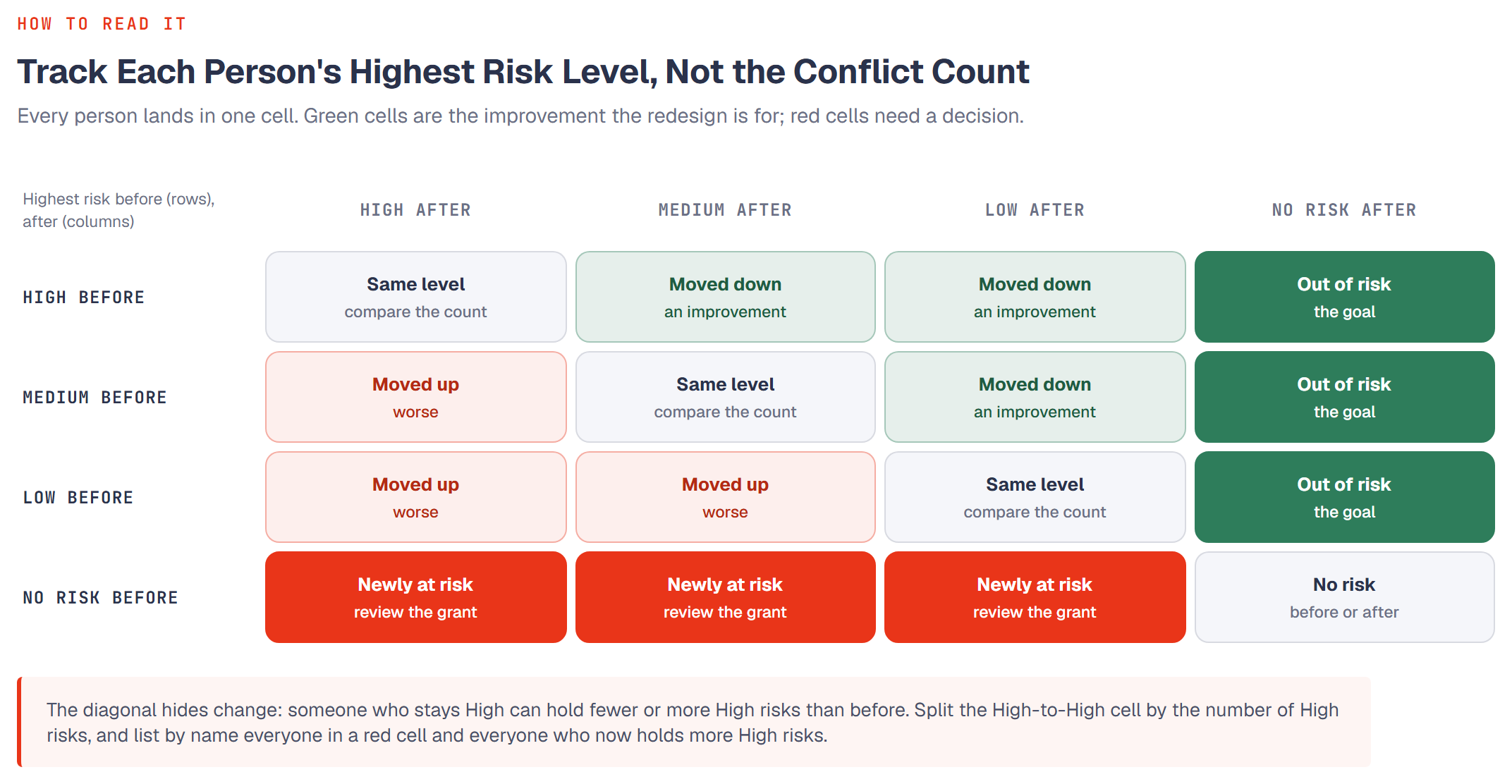
For this estate, as shares of the about 700 people compared (rows before, columns after):
| Before | High | Medium | Low | None |
|---|---|---|---|---|
| High | 36.6% | 0.4% | 0.1% | 6.5% |
| Medium | 0% | 0.1% | 0% | 0% |
| Low | 0% | 0% | 0% | 0% |
| None | 1.3% | 0% | 0.1% | 54.7% |
Then split the High row:
| People who held a High risk before | Share | What to do with it |
|---|---|---|
| No risk left | 15% | Report as the gain |
| Moved down to Medium or Low | 1% | Report as the gain |
| Still High, fewer High risks | 2% | Partial progress; still a High-risk holder |
| Still High, same number of High risks | 77% | Unchanged; check nobody swapped one High risk for another |
| Still High, more High risks | 5% | Name each person and the roles that added the risk |
Add the people newly holding a High risk: fewer than 10, each on the review list. Almost everyone with a conflict before already held a High risk, so people left risk entirely or stayed High; "moved down" barely happened.
Split the change into its causes
The total change mixes three causes with different owners. Score each state in between: new assignments as if people still held the original roles, then the new role content, then late grants of old roles. Figures are the change from before.
| State | People | High risks | All |
|---|---|---|---|
| After reassignment and revocation, as if still the original roles | -14% | -10% | -5% |
| Plus the new role content | -14% | -11% | -8% |
| Plus old roles granted after the plan (the final result) | -12% | -9% | -6% |
Reassignment and revocation did all of the reduction in people. New role content trimmed conflicts for people who kept others but freed nobody. Late grants took part of the gain back. So review the late grants first, then rebuild the few role families carrying most conflicts around business processes; splitting them by license won't separate duties.
Check the data before you trust the result
- Silent export caps. Security exports stop at 1,000,000 rows without warning. Check row counts, and for extractions in parts, remove duplicates.
- Missing roles. One export lacked the newest roles, so their holders couldn't be assessed. Stop the run if an assigned role doesn't resolve to role content.
- Two English variants. The user-role and security exports spelled standard role names differently, so name matching silently dropped holders. Match on role identifiers.
- A flag with no information. One user list marked every account enabled, so inactive accounts couldn't be excluded there. Say so.
- Design summaries drop restrictions. A design catalog taking access levels from license data loses every Deny and invents conflicts. Score the real security extraction.
Report it to four audiences
Each reader asks a different question.
| Reader | Question they ask | What they get |
|---|---|---|
| Executives | Is it better? | One page. Here: yes, 12% fewer people hold a conflict, 16% of High-risk holders left High risk, and those gaining High risks are listed for review. |
| Risk and control owners, security administration | Who and what do I act on? | Results by person, risk, and role family, with who needs a decision. |
| Analysts and auditors | Can I trust the number? | A reconciliation with the delivered reports, engine validation, both ruleset variants, limits, and reproduction steps. |
| Anyone checking a figure | Who exactly? | A workbook naming the people behind each headline figure. |
A conflict between a new role and a role outside the mapped scope isn't counted on either side. Legal entities aren't considered, which overstates, never hides. A menu-item ruleset doesn't see service operations or data entities. The ruleset was an adjusted third-party audit ruleset with known defects, not validated for this estate, so it shows the direction of change, not absolute exposure. Other estates' ruleset ranges come from their own before-state snapshots.
A before-and-after SoD answer is only as good as what stays fixed: engine, ruleset, people, and scope. Hold those, report people and their highest risk level, and split the change into its causes. Set it up before the redesign ships, while the old extraction exists.
Related reading: the most powerful role is invisible to your SoD engine explains why administrators get their own list, and shipping de-provisioning as a sign-off list covers the removals that make the change real.