
In October 2026 we scored five Dynamics 365 Finance and Operations estates for segregation of duties twice, with the roles people held before a security remediation and after: one SoD engine, one ruleset, the same people. Does license remediation, which cuts each role down to what people actually use, remove conflicting access as a side effect, as it's often sold?
Ask how many people moved down or out of High risk, not how many conflicts went away. At four license-driven redesigns the conflict count fell, and the answer to the first question was zero.
Four estates, about 2,100 active people, were redesigned by our own role engine, which builds roles from usage evidence and license cost. We scored them at the designed end state, with every proposed removal approved. The fifth was remediated earlier by a different method: main roles split into versions by license type, people reassigned to the versions they need, and old roles revoked. We measured it live, for the about 700 people who had moved to the new roles.
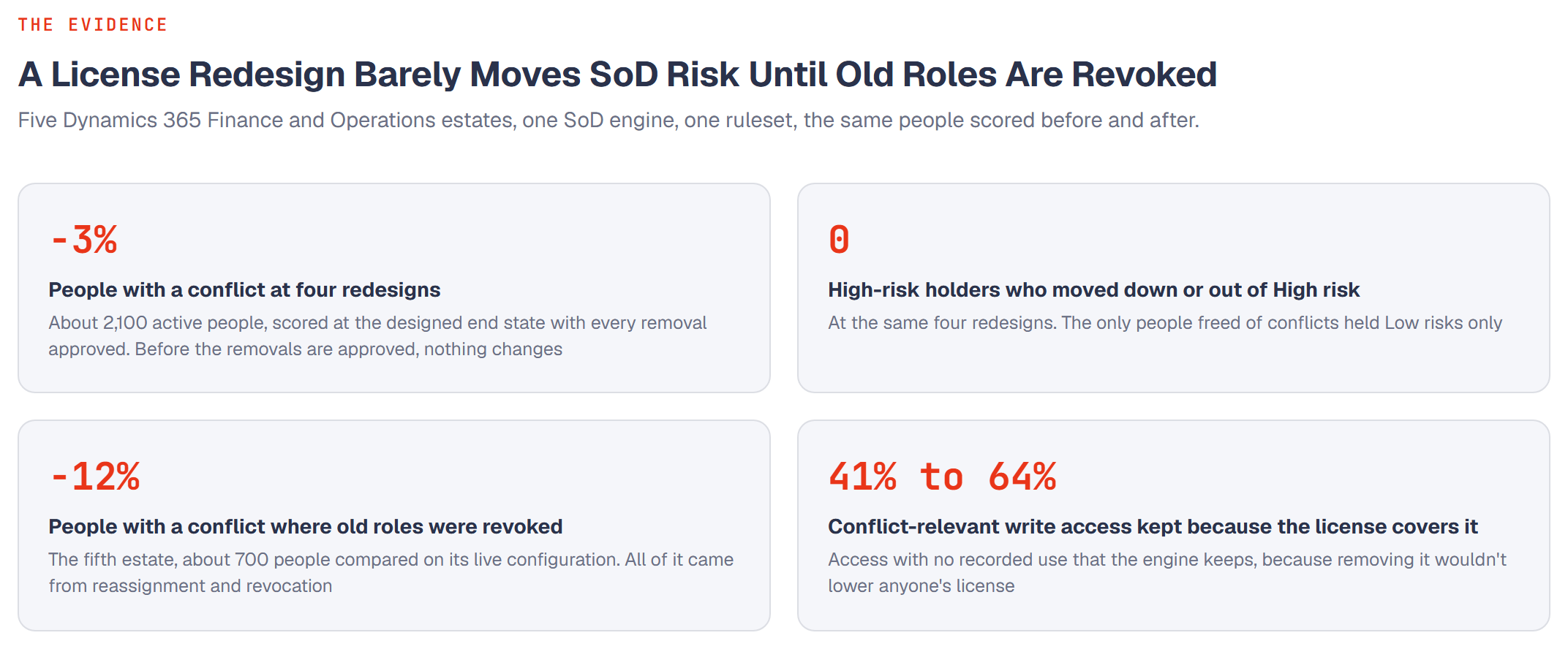
The short answer
| Question | What the five estates showed |
|---|---|
| Did the four redesigns reduce SoD risk? | Barely. People with at least one conflict fell 3% and High-risk conflicts 0.4%, and only once every removal is approved. |
| Did anyone get out of High risk? | Not at the four redesigns: no High-risk holder moved down or out of High, and nobody whose worst risk was Medium moved down. At the fifth estate, 16% of High-risk holders did. |
| Why so little? | The engine removes access that costs money. It keeps 41% to 64% of conflict-relevant write access because the license each person already needs covers it. |
| Where did the fifth estate's 12% come from? | From reassignment and revocation. Splitting the roles by license type freed nobody of a conflict. |
| Can a remediation make SoD worse? | For a few people, yes. At the four redesigns about 10 people who already had conflicts gained more. At the fifth estate about 5% of High-risk holders gained more High risks, and fewer than 10 people their first. |
How we measured it
A conflict here is one person able to change data in both business processes of one risk in the ruleset, for example both purchase orders and vendor product receipts. Write access means Update, Create, Delete, or Correct granted and not denied, with Read not denied; a Deny on any of a person's roles applies across all of them. Read-only access never counts.
Every risk carries a level, High, Medium, or Low, like the Severity on a segregation of duties rule in Dynamics 365. Both sides take role content from the same security extraction, so only the role assignments differ. The scope is menu items, legal entities aren't considered, and system administrators are left out because they can do everything regardless of role.
Fewer conflicts, the same people at risk
Counting conflicts flatters the redesigns. Of the conflicts the four designs remove, 76% sit with people who hold a High-risk conflict, and not one of them loses their last High risk. The only people freed entirely held nothing but Low risks.
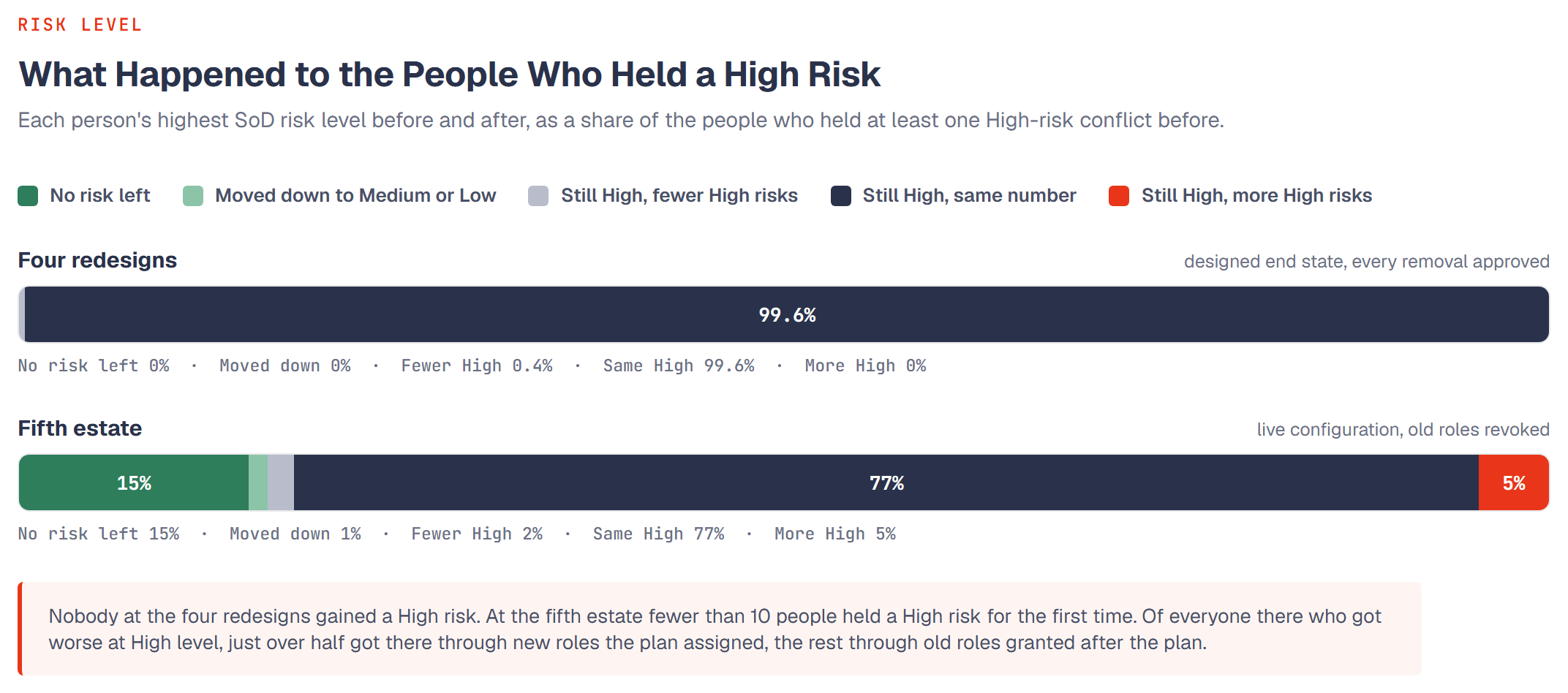
The fifth estate moved: 16% of the people who held a High risk no longer do, almost all with no risk left at all. Some got worse at High level. Of those, just over half did so through new roles the plan assigned, the rest through old roles granted after the plan on top of the new ones.
License-optimal isn't least privilege
The engine removes access that's unused and would raise someone's license. Unused access already covered by the person's license stays, because removing it saves nothing. For segregation of duties that's the wrong way around: a conflict doesn't care what the seat costs.
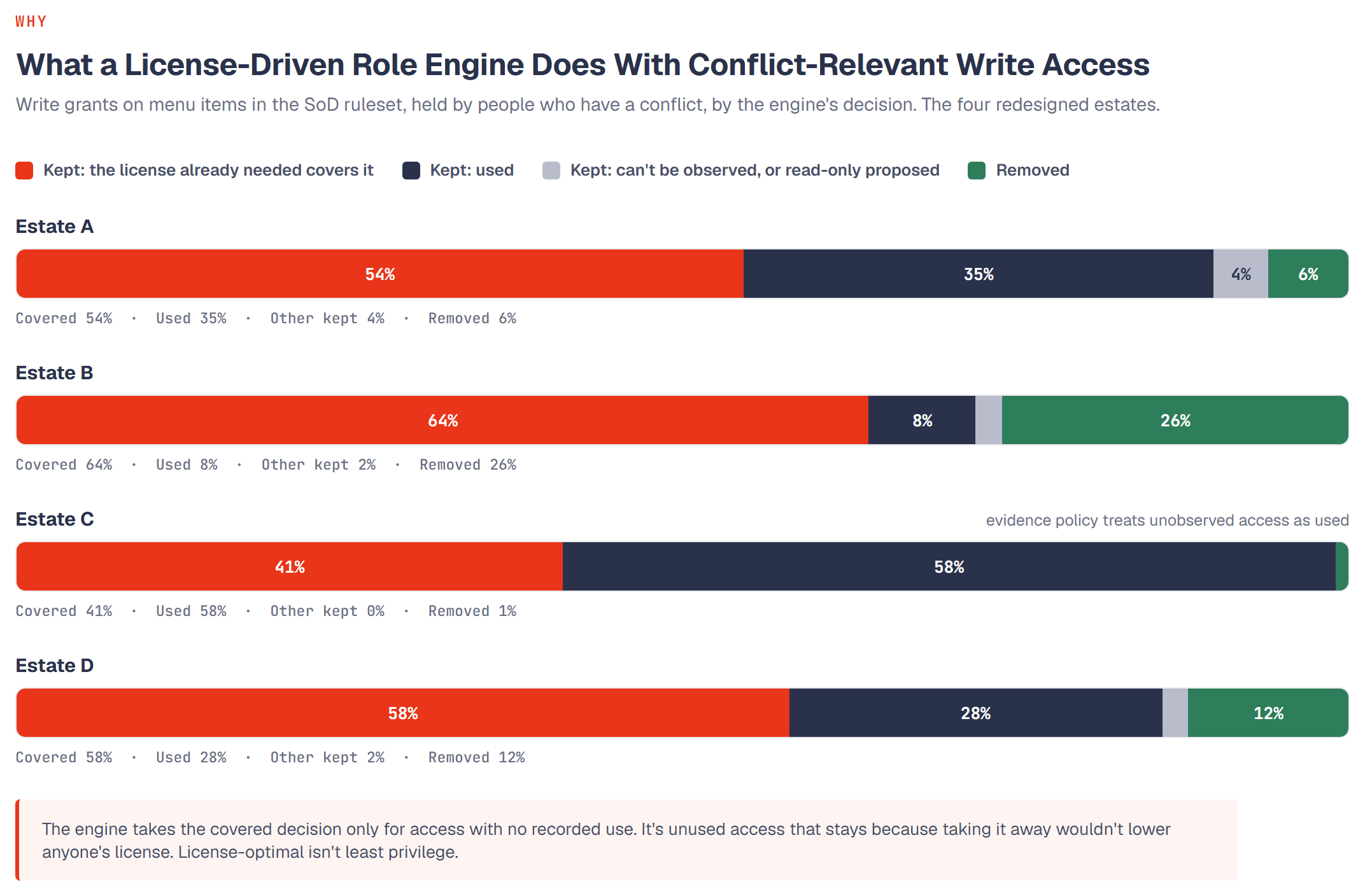
Across the four estates, 41% to 64% of the conflict-relevant write access held by people with conflicts stays for that reason; the engine removes 1% to 26%. Estate C keeps the most as used because, with short usage data, its evidence policy counted unobserved access as used. How much unused access stays is a policy choice, covered in three ways to treat access with no usage evidence.
| Estate | How it was scored | People with a conflict | High-risk holders who moved down or out |
|---|---|---|---|
| A | Designed end state | 8% fewer | None |
| B | Designed end state | 21% fewer | None |
| C | Designed end state | Less than 1% fewer | None |
| D | Designed end state | No change | None |
| A to D together | Designed end state | 3% fewer | None |
| Fifth estate | Live, old roles revoked | 12% fewer | 16% |
The gain is uneven, from about a fifth of conflicted people freed at Estate B to nobody at D. B also removed the largest share of conflict-relevant access, but that isn't a rule: D removed twice A's share and freed nobody.
The SoD value is in the removals
A redesign changes nothing until the old roles go. Our revocation keeps every old role whose access the new roles don't fully cover until the customer approves its removal, for the reasons in shipping de-provisioning as a sign-off list. The 3% arrives the day the approvals land, not with the import.
The few conflicts a redesign adds don't wait for approval. At the four redesigns about 10 active people who already had conflicts gain more, most likely through shared roles that give every member a privilege once enough need it, and nobody gets a first conflict. A full-cutover package delivers those with the import; an add-only delivery can hold them back.
At the fifth estate, where removals were carried out, people with a conflict fell 12% and High-risk conflicts 9% across all their roles, all of the drop in people from reassignment and revocation. Person by person, the license versions of the roles freed nobody: 59% of the versions of conflict-carrying roles keep every conflict of the original, and the rest trimmed some conflicts, but only from people who still had others. Old roles granted after the plan gave a few people new conflicts.
The two scoring bases aren't interchangeable: Estates A to D at the designed end state and the fifth estate live, counting old roles granted after the plan as current access. The ruleset is an adjusted third-party audit ruleset with known defects, not validated for any of these estates, so read the figures as direction of change, not absolute exposure. Under a narrower variant of it, the number of people with a conflict at A to D doesn't move at all, while the fifth estate's direction holds. Estates are anonymized, and sizes are rounded.
What to ask for in a redesign
- Measure SoD before and after, the same way. One engine, one ruleset, the same people, next to the license saving. How to compare before and after, person by person walks through the method.
- Ask how many people moved down or out of High risk. A falling conflict count can hide a High-risk population that didn't change at all.
- Get the removals approved and carried out. Until the old roles go, the SoD gain is zero, while conflicts the new roles add are already live.
- Ask for an SoD-weighted scenario next to the license-optimal one. A stricter policy on unused access removes conflict-relevant access the seat already pays for. Price it, then decide.
- Don't let a shared role add a conflict. A pooled privilege shouldn't reach a member who doesn't hold it today if it gives them a new conflict.
- Redesign the roles that carry the conflicts around business processes. Splitting a role by license type keeps its conflicts; separating duties means putting the conflicting processes in different roles.
A license redesign is a cost project with a small SoD side effect that only shows up once old roles are revoked. If the goal is fewer people with High-risk access, it needs its own target, its own before-and-after measurement, and roles built around business processes, not license tiers.
None of this makes license remediation the wrong project, just a different one. Quote the license saving as the license saving, and keep "and it fixes SoD" off the slide unless the people who held a High risk before have been counted again.
Related reading: how to compare SoD before and after a redesign, your SoD conflict count is mostly an artifact of the ruleset (why the ruleset sets the size of the answer), three ways to treat access with no usage evidence, and segregation of duties in D365 F&SC.