
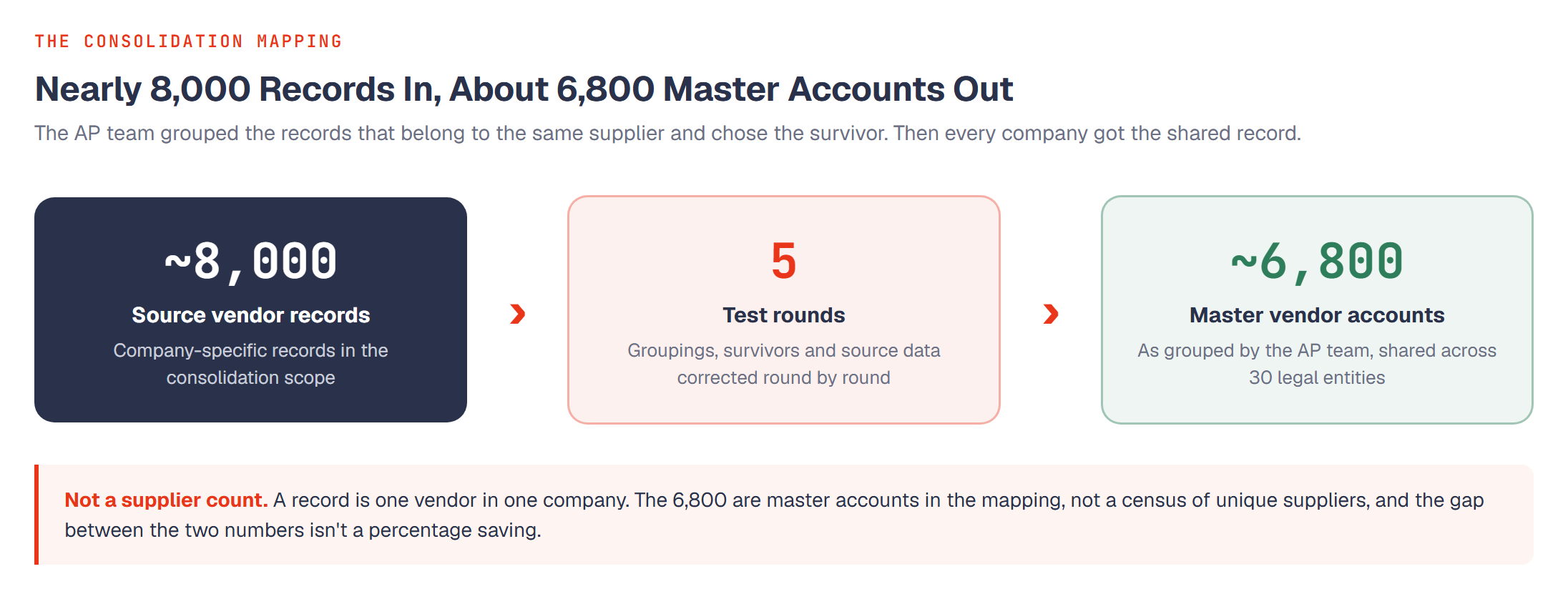
Nearly 8,000 vendor records were mapped to about 6,800 master vendor accounts and shared across 30 D365 legal entities, after five full rehearsals and a production cutover of about four hours. The number that mattered most to accounts payable wasn't a count. It was being able to trust the vendor record in front of them.
Thirty legal entities, one supplier network, and vendor lists that had grown apart over years. The same supplier could have one address in one company, another email in a second, and different payment details in a third. When the question is which record to trust, the honest answer had become: it depends who you ask.
Two-part case study. This is part 1. Part 2 covers the technical side: five test rounds and what they changed.
In plain words: in D365 Finance and Supply Chain, every legal entity keeps its own vendor records. A group that buys from the same suppliers ends up with the same supplier entered many times, each copy edited by different people. Vendor consolidation decides which copy is right, points everything at it, and then keeps the companies in step.
Scope
| Item | Detail |
|---|---|
| System | D365 Finance and Supply Chain Management |
| Legal entities sharing vendor data | 30 |
| Vendor records in scope | Nearly 8,000 |
| Master vendor accounts after mapping | About 6,800, as grouped by the AP team |
| Full rehearsals | 5 |
| Production cutover | About 4 hours, one weekend window |
| Connected systems | Invoice Capture, Microsoft Fabric, Power BI |
What we found
Duplicates were the visible part. The harder part was that duplicates disagreed. A record chosen to survive might be on hold. The record scheduled for retirement might hold a tax identifier the survivor lacked. Two records of one supplier might pay into different bank accounts.
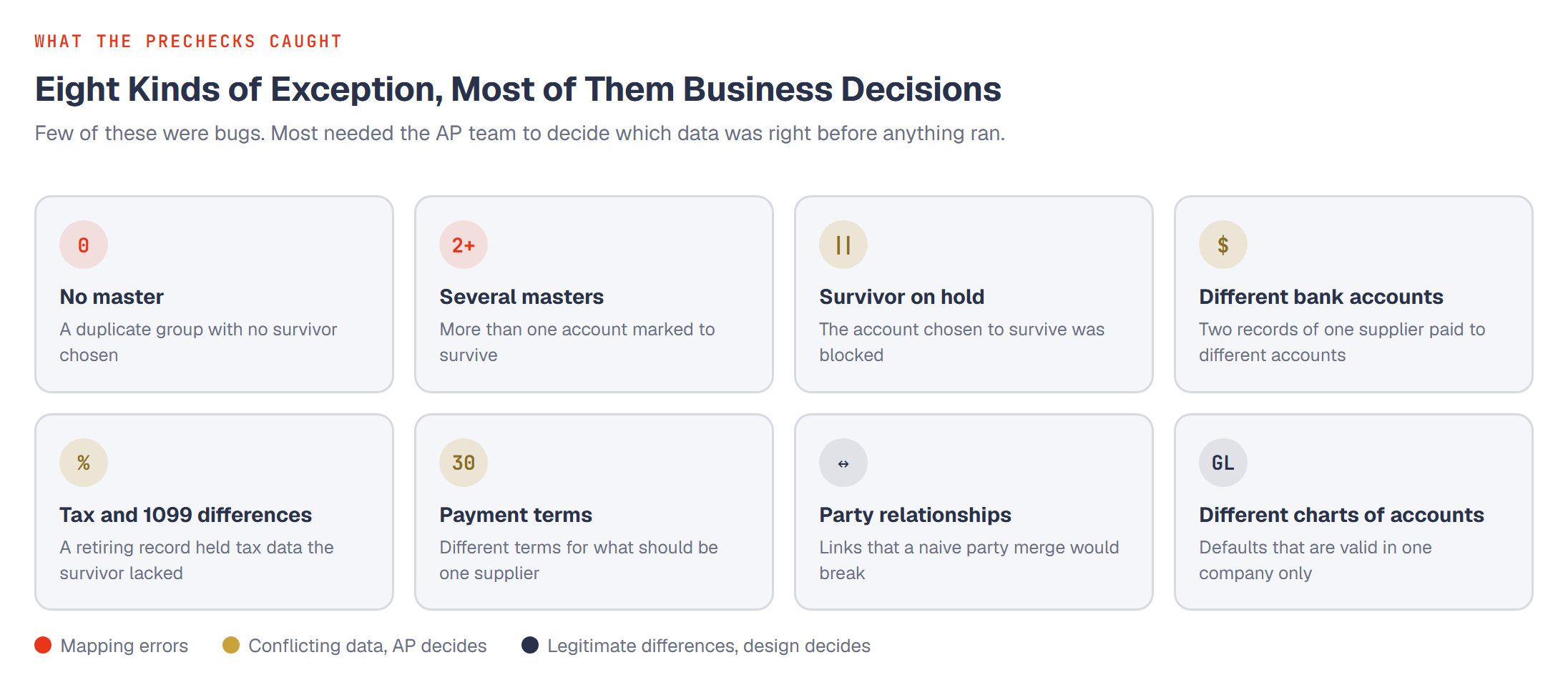
Some differences were legitimate. Companies with different charts of accounts need different default ledger accounts, and copying one company's defaults to another would have created invalid accounting the first time someone entered an invoice. So the job wasn't "make every company identical". It was deciding, field by field, what is genuinely shared and what stays local.
What we changed
The AP team owned every business decision: which records belong together, and which one survives. Our consultants and developers analyzed their proposals, ran AI-assisted checks over the data to surface inconsistencies, and showed the consequence of each choice before anything ran. AP then corrected the records at the source in D365.
That loop ran five times, one full rehearsal per round on a copy of production. Something we didn't plan for: cleanup encouraged more cleanup. Once the AP team could see the data clearly, they found problems beyond duplicates, like missing default bank account selections and gaps in default accounts, and fixed them too. By the final rehearsal, the team started execution with zero known exceptions.
Consolidation software can move references. Only the people who know the suppliers can say which record is true, so give them the evidence and keep the decision with them.
One identity, thirty company records
After consolidation we switched on cross-company duplicate record sharing for vendor data across all 30 legal entities. Each company still has its own vendor record, and the shared fields stay in step.
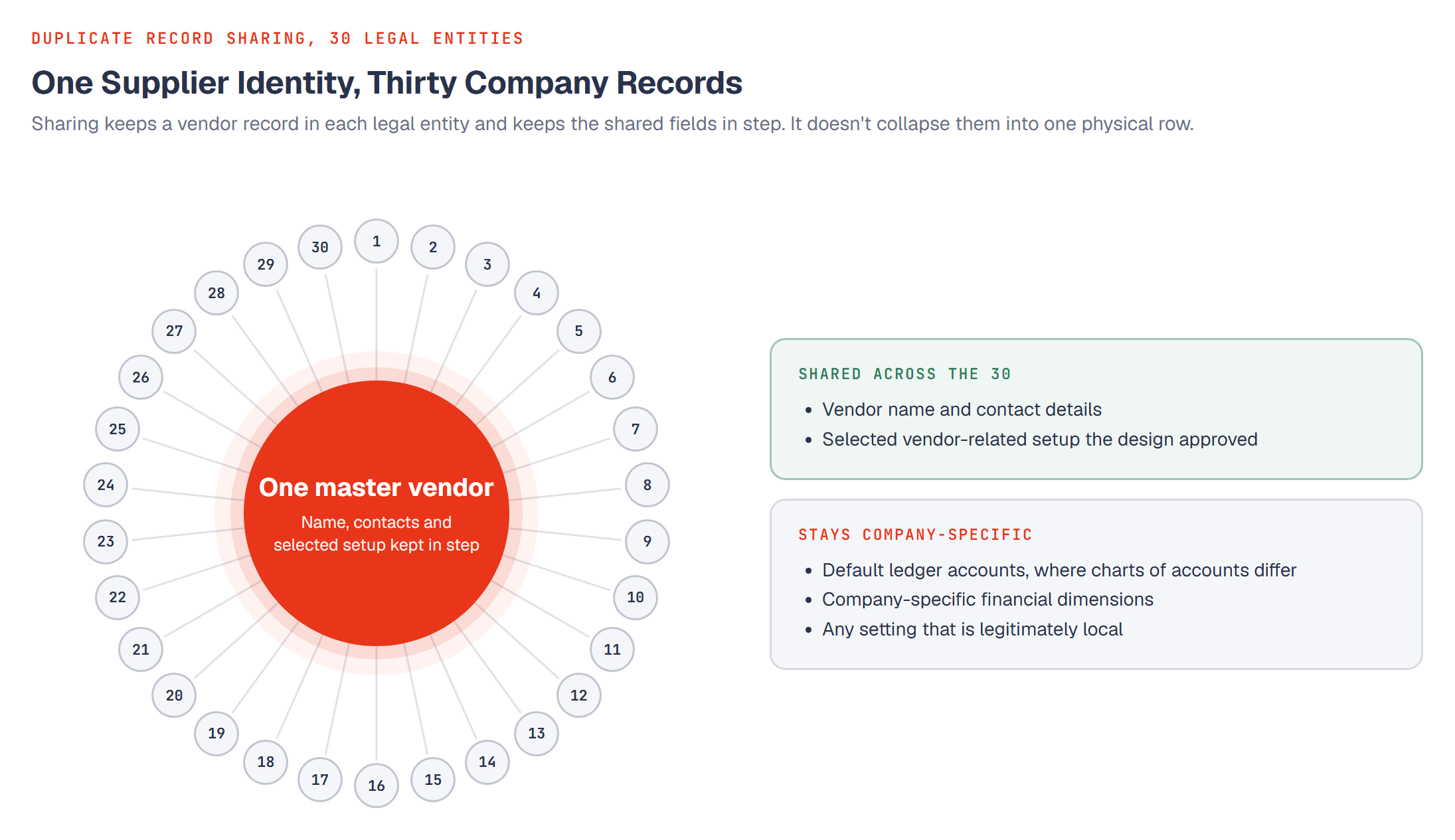
That's what made the result usable. When a supplier changes its contact details, the change is made once. Before creating a vendor, AP can search one shared list by name, tax identifier, email or phone. And the legitimately local setup stays local.
The cutover
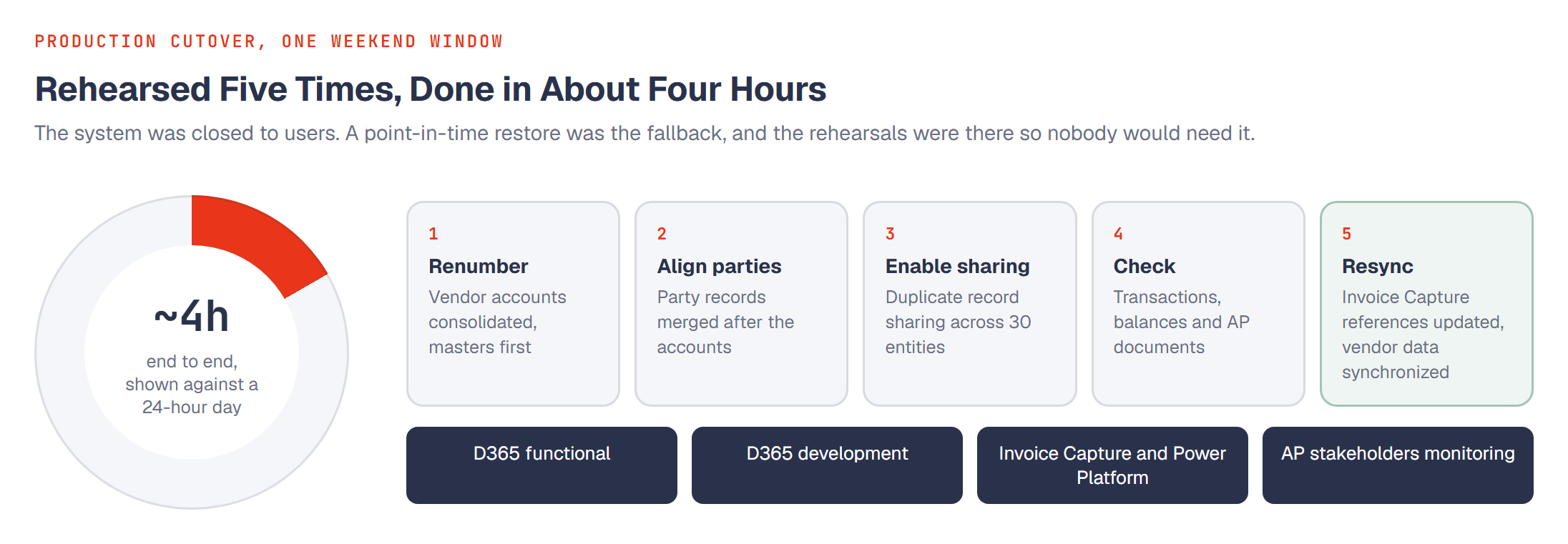
Production ran during a planned weekend window with the system closed to users. A small team covered D365 functional work, development, and Invoice Capture with Power Platform, while key AP stakeholders watched the results. A point-in-time restore was the fallback. The rehearsals were there so nobody would need it.
One dependency did surface after go-live. Some analytics in Microsoft Fabric and Power BI still showed old vendor references, carried in financial dimension data on ledger records. We corrected the source in D365, resynchronized and checked the reports, in about a day. Part 2 covers what we now test before go-live because of it.
We didn't measure an ROI, a change in AP processing time or a lower rate of new duplicates, so we don't claim one. The outcome below is what the AP team reported. The counts are approximate, and new vendors created since go-live haven't been audited for duplicates.
What changed for accounts payable
- One place to check before creating a vendor. A shared list searchable by name, tax identifier, email or phone.
- One update instead of thirty. Shared details change once and reach every company.
- Fewer extra checks at month-end. AP reported needing fewer additional validations across companies.
- A better reference set downstream. Invoice Capture works against the consolidated vendor accounts.
The strongest feedback wasn't a percentage. The AP team said they could finally trust and navigate their vendor data.
Vendor deduplication counts rows. A vendor master is a control the business relies on. If your group runs many legal entities on shared suppliers, this approach applies once two things are true: AP is ready to own the survivor decisions, and you're willing to rehearse until a full run on fresh data finishes with zero known exceptions.
Frequently asked questions
Does cross-company sharing create one vendor record for all companies?
No. Duplicate record sharing keeps a vendor record in each legal entity and keeps the shared fields identical. Company-specific setup, like default ledger accounts where charts of accounts differ, stays local.
Who decides which vendor record survives?
The accounts payable team, because they know the suppliers. The consultants' job is to surface conflicts, like a survivor on hold or a missing tax identifier, and show the consequence of each choice.
How long did the production cutover take?
About four hours in a weekend maintenance window, after five full rehearsals on copies of production.